Home / Wildlife
Namibia Wildlife Guide
From desert-adapted animals to 644 recorded bird species — explore Namibia's wildlife by habitat, region, and season.
Wildlife Across Contrasting Habitats
Namibia's wildlife ranges from the arid Namib and fog-influenced Atlantic coast to Etosha's pans and the river systems of the Zambezi Region. Community-based natural resource management gives registered conservancies rights and responsibilities over wildlife and tourism on communal land. NACSO's current overview lists 86 registered conservancies covering 166,184 km² and including approximately 244,587 people.
Adaptation is best understood as behaviour and ecology, not as a promise of a separate species or a sighting. Some elephants range along ephemeral rivers, coastal insects use fog moisture, and predators adjust to local prey. Conditions and populations still vary by region and year.
Five Large Mammals by Region
All five occur within Namibia, but not in one standard Etosha itinerary: Cape buffalo are associated with the wetter north-east. The labels below prioritise geographic context over volatile population estimates.
African Elephant
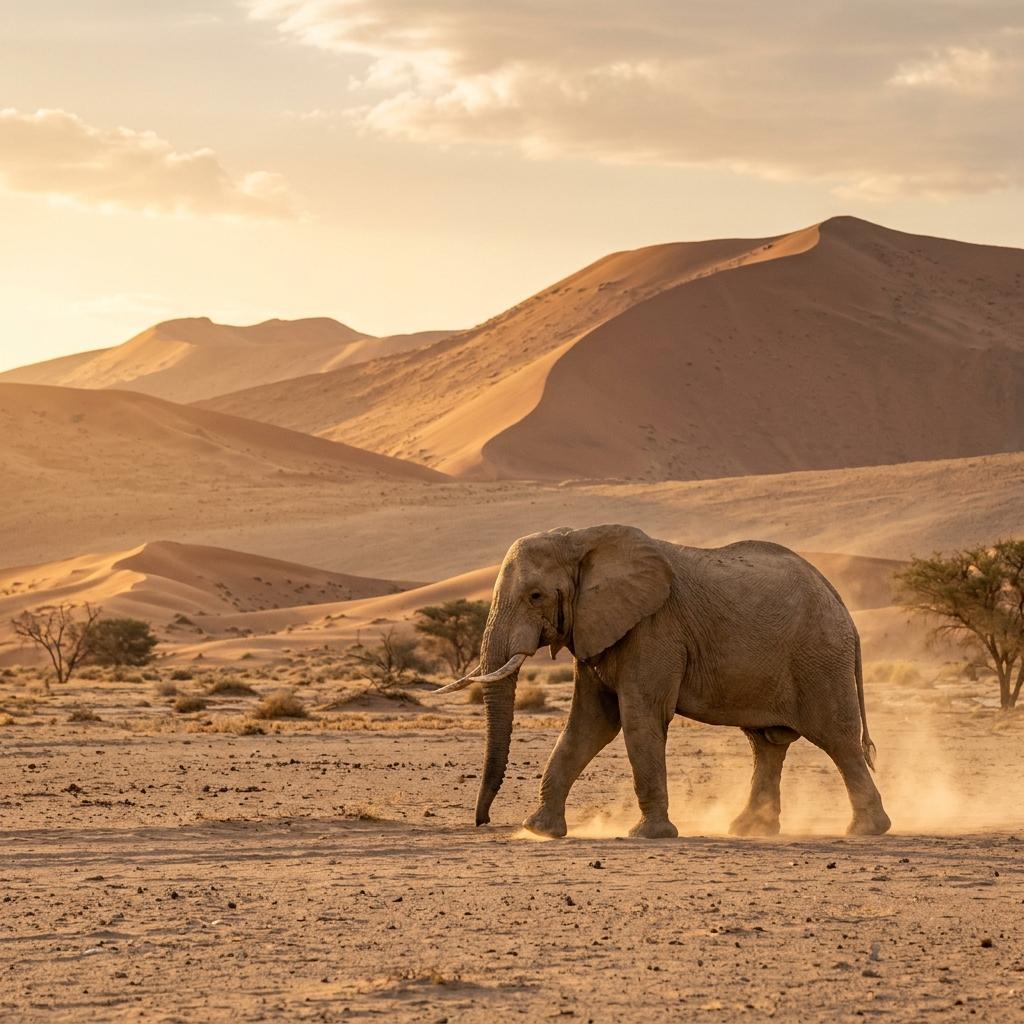
Elephants occur in several distinct landscapes. Some north-western groups use ephemeral river systems and are described as desert-adapted, but they are not a separate species and local population trends differ from the national picture.
Black Rhino
Namibia is an important black-rhino range state. Population estimates and precise locations are security-sensitive and change over time, so use official conservation reports rather than lodge marketing counts.
Lion
Lion ecology differs between Etosha, the arid north-west, and the wetter Zambezi landscape. A guide can improve interpretation, but no operator can guarantee a sighting.
Leopard
Leopards occur across suitable habitat but are difficult to see. Compare ethical viewing practices and avoid treating captive or habituated encounters as equivalent to a wild sighting.
Cape Buffalo
Buffalo occur in Namibia's wetter north-east, including the wider Bwabwata, Mudumu, and Nkasa Rupara landscape. They are not part of an Etosha safari, so Namibia's five species usually require more than one region.
Desert-Adapted Species
| Species | Where to Find |
|---|---|
| Desert-Adapted Elephant | Damaraland (Huab & Hoanib rivers) |
| Desert-Adapted Giraffe | Damaraland |
| Gemsbok (Oryx) | Namib Desert, Sossusvlei |
| Hartmann's Mountain Zebra | Damaraland, Naukluft |
| Brown Hyena | Skeleton Coast |
| Namibian Sand Gecko | Namib Desert dunes |
| Fog-Basking Beetle | Namib Desert coast |
| Sidewinder Adder | Namib Desert dunes |
Marine & Coastal Wildlife
| Species | Season |
|---|---|
| Cape Fur Seal | Colonies year-round; breeding activity varies |
| Bottlenose Dolphin | Possible year-round; sightings vary |
| Heaviside's Dolphin | Possible year-round; sightings vary |
| Flamingos (Greater & Lesser) | Numbers follow tide, food, and season |
| Coastal & Pelagic Birds | Resident and migratory mix |
Birding in Namibia
MEFT's national biodiversity overview records 644 bird species and counts 13 as endemic to Namibia. Most of those also occur just across the border in Angola or South Africa; the Dune Lark of the Namib is usually treated as the only bird found nowhere else. Desert, escarpment, woodland, wetland, and marine habitats each contribute a different group, so a national bird list cannot be assigned to a single region.
Walvis Bay's lagoon is important for coastal waterbirds, Etosha changes with pan and waterhole conditions, and the Zambezi Region adds riverine species. Migrant timing, rainfall, tide, and local water levels all matter; check recent sightings rather than relying on a fixed flock count or a single nationwide “best” season.
How to Assess Conservation Claims
Namibia's Community-Based Natural Resource Management (CBNRM) program is a widely studied framework that allows rural communities to manage and benefit from wildlife on communal land. Many conservancies form joint-venture partnerships with safari operators and lodges, but ecological and financial outcomes differ between places and reporting periods.
The quality of that benefit varies by operator and property. Before booking, look for specific evidence: named conservancy partners, employment details, benefit-sharing notes, conservation reporting, and recent reviews that describe how the model works in practice.
86
Registered conservancies
166,184 km²
Conservancy area
244,587
People included (approx.)
Plan a Wildlife-Focused Route
From Etosha waterholes to guided northwest tracking, compare seasons, sighting uncertainty, conservation claims, and operator policies before choosing an experience.
Explore Safari Options