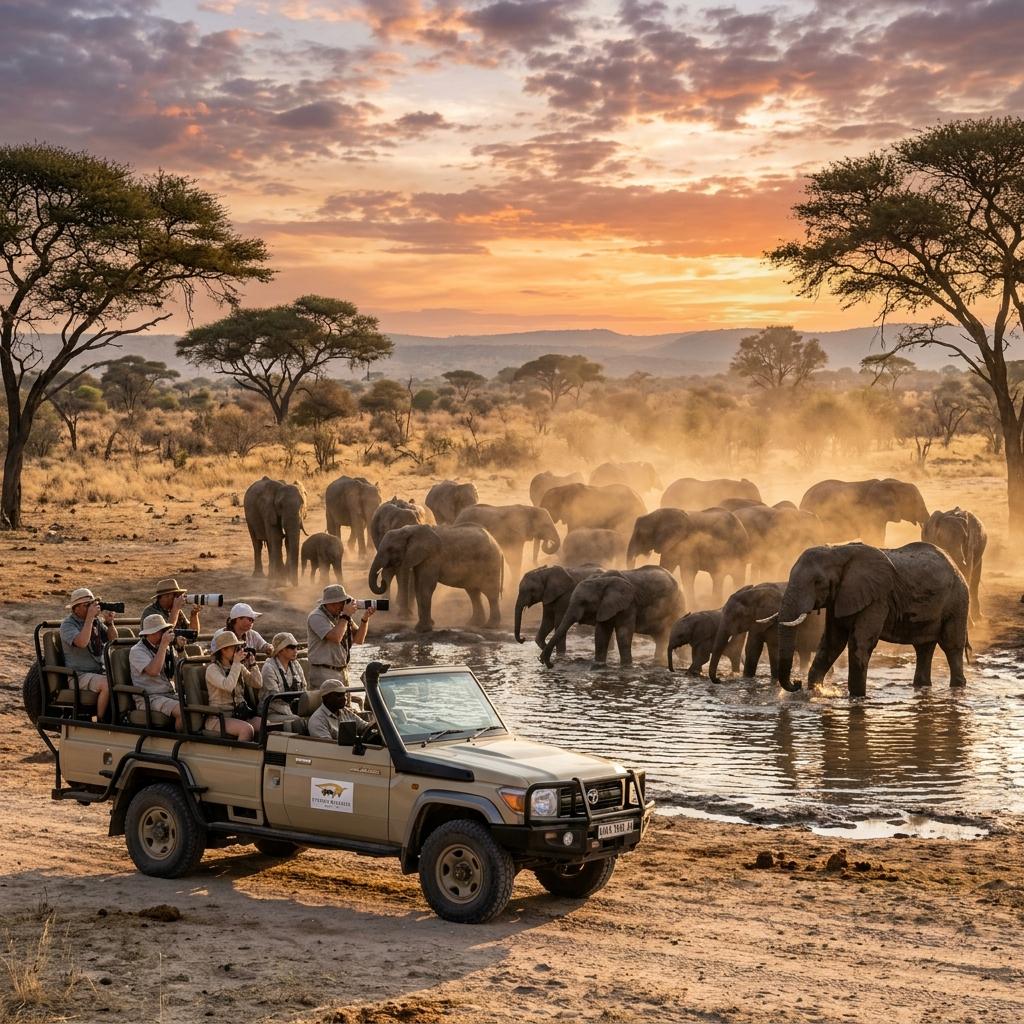
Choose where wildlife viewing fits and whether to self-drive, join guided activities, use private reserves, or plan a fly-in stay.
Start With the Wildlife Setting and Travel Format
A Namibia safari is shaped by open landscapes, long distances, desert-adapted wildlife, and the waterhole logic of Etosha. It can feel very different from denser bushveld or migration-focused safari regions, especially for travelers who combine self-drive days with selected guided activities.
Namibia has a formal communal-conservancy system that can connect wildlife management and tourism with local institutions. Use this guide to choose the safari setting and format, and verify any community-benefit claim against a named conservancy or partner. Once operators send proposals, use the guided-safari quote worksheet to compare credentials, group structure, inclusions, and contract terms.
Types of Safari Experiences
Guided Game Drives
Expert-led safari drives in open-top vehicles through Etosha National Park can improve interpretation and wildlife tracking. Compare guide credentials, vehicle type, included park fees, and recent reviews before booking.
Group Travel Safaris
Small-group safaris can offer value through shared accommodation, transport, and guide costs. Confirm group size, single supplements, cancellation terms, and whether departures are guaranteed.
Private & Luxury Safaris
A private vehicle, specialist guide, fly-in transfer, or higher-service lodge can buy time and flexibility—not guaranteed sightings. Verify exclusive-use terms, luggage limits, meals, child policies, and the exact areas each activity enters.
Photography Safaris
Photography-focused safaris should prioritize golden-hour positioning, hides at waterholes, and extended time with subjects. Ask whether the guide has wildlife photography experience and whether vehicle seating is limited.
Conservation Safaris
Conservation-focused trips can be worthwhile when the operator explains the partner, activity ethics, conservation objective, and community or research benefit clearly enough to verify.
Birding Safaris
Birding routes can combine the coast, central highlands, desert endemics, and northeastern wetlands. Ask for a named specialist guide, a season-specific plan, and an honest distinction between possible and likely species.
Species and Areas to Research
No ethical operator can guarantee a wild-animal sighting. Use this table to shape questions about habitat, season, guide experience, and encounter practices.
Species
Areas associated with the species
Planning check
African elephant
Etosha and parts of northwest/northeast Namibia
Ask how the route, water, rainfall, and local guiding affect the chance of a sighting.
Black rhino
Etosha and guided northwest conservancy areas
Use legitimate guides; operators should protect sensitive location information.
Lion
Etosha and parts of northwest Namibia
Presence does not make a sighting predictable. Compare guide skill and time in habitat.
Leopard
Scattered habitats and selected reserves
Elusive and never guaranteed; scrutinize any captive-wildlife or encounter claims.
Cheetah
Central and northern rangelands and selected reserves
Ask whether an experience involves free-ranging, rehabilitated, or captive animals.
Oryx (gemsbok)
Desert and arid regions
Commonly associated with Namibia’s arid landscapes, but wildlife remains mobile.
Giraffe
Etosha, conservancies, and suitable northern habitats
Water and vegetation influence local distribution.
Cape fur seal
Recognized mainland and coastal colonies
Access, breeding activity, wind, fog, and animal welfare conditions vary.
Family safari decisions
Plan the Day Around the Family, Not a Sightings List
A family safari works when driving time, heat, meals, restrooms, rooms, and backup plans are settled before the wildlife schedule. Ages alone do not decide readiness: attention span, sensory needs, sleep, motion tolerance, and how easily the day can change matter just as much.
Attention span and drive length
Plan around the least vehicle-tolerant traveler, not the adults’ maximum endurance.
Ask for realistic time in the vehicle, how often the day can be shortened, and whether a private drive can return early. Two focused viewing periods with a proper break may work better than one long loop.
Age and activity rules
Confirm every child policy before choosing a shared drive, walking activity, or lodge.
Minimum ages, seating and restraint arrangements, private-vehicle alternatives, pool supervision, room occupancy, and whether children can join early or night departures all vary by supplier.
Heat, shade and safe stops
Build the day around places where the family can legally leave the vehicle and cool down.
Map rest camps and designated stops, confirm working air conditioning with the rental company, and carry enough drinking water. Never treat a quiet roadside as an informal toilet or stretch stop.
Meals and familiar routines
Check whether game-drive hours and transfer days fit the family’s normal meal pattern.
Ask about breakfast packs, early dinners, dietary needs, refrigeration, highchairs or cots where relevant, and what can be bought at the next camp. Do not assume every remote stop has a full shop.
Health and medical planning
Take destination-specific advice from a qualified clinician and turn it into a written travel plan.
Discuss routine care, prescription storage, allergies, motion sickness concerns, and what documentation to carry. Ask each lodge how it contacts help; this guide does not replace medical advice.
Rooms, rest and adult cover
Choose the room layout before choosing the lodge category.
Confirm who sleeps where, whether rooms interconnect, distances between tents, night escort policies, and whether one adult can remain with a resting child while another joins an activity.
A useful booking test
Ask the lodge or operator what happens if a child cannot join, wants to return early, becomes unwell, or needs a meal outside the usual schedule. A precise answer is more useful than a generic “family-friendly” label. Before paying, run the trip-readiness checklist and check the activity and evacuation questions in the travel-insurance guide.
Self-drive safari decisions
Independence Comes With Route Ownership
A self-drive safari gives you control over waterhole time and rest breaks. It also makes you responsible for the rental contract, park instructions, fuel margin, navigation, gate timing, and the response to a breakdown. If that trade-off feels wrong, combine a simpler road route with lodge-led or NWR-guided drives.
1
Vehicle and rental terms
Decision: Choose the vehicle from the approved route, current road conditions, passenger space, and support plan—not from safari aesthetics.
Verify: Written permission for every road type, tyre and windscreen cover, spare-wheel provision, child-seat availability, after-hours support, replacement-vehicle terms, and where recovery charges begin.
2
Park rules and permits
Decision: Treat the instructions issued at the gate as the operating rules for that visit.
Verify: Current entry procedure, closing time, open visitor roads and stopping places. Etosha regulations restrict being outside the vehicle away from rest camps or campsites and prohibit ordinary travel between sunset and sunrise.
3
Route and daylight margin
Decision: Set a final turnaround time before starting each loop.
Verify: Road notices, detours and the actual time to your camp or exit gate. Leave a generous buffer for slow traffic, wildlife on the road, photo stops, and navigation errors instead of racing a closing gate.
4
Fuel, water and food
Decision: Make the next reliable supply point part of the route plan.
Verify: Fuel and shop availability shortly before travel, then refill early. Carry water and a simple meal reserve, but do not use food, water, or fuel calculations to justify an overlong park crossing.
5
Navigation and wildlife conduct
Decision: Use a park map and open visitor roads; do not chase social-media locations.
Verify: Download offline navigation, record your accommodation and gate on paper, keep noise down at waterholes, never crowd animals, and do not share sensitive rhino locations in real time.
6
Breakdown and emergency response
Decision: Know who takes responsibility before a problem happens.
Verify: Save rental, lodge, insurer, gate and emergency contacts offline. Ask how support works inside a park, what happens without mobile signal, and whether your policy covers the activities and evacuation arrangements you selected.
Rental first
Get route permission and support terms in writing before choosing the car.
Refill early
Treat camp fuel and shop status as changing facts to reconfirm, not fixed route assumptions.
Turn around early
Protect the return margin even when a waterhole, loop, or sighting is tempting.
Etosha is large enough that accommodation and gate choices shape the safari more than a long wishlist of waterholes. NWR currently lists Okaukuejo, Halali, Namutoni, Dolomite, Onkoshi, and Olifantsrus among its in-park facilities; verify access, services, activities, and operating status directly before making them route anchors.
Sector and base
Planning decision
Use southwest/Okaukuejo, central/Halali, east/Namutoni, and the western facilities as routing shorthand—not as separate wildlife promises.
Confirm shortly before travel
Which roads, waterholes, gates, camps, fuel points, and guided activities are currently open around each proposed base.
Entry and exit gates
Planning decision
Choose gates from the route before and after Etosha. A convenient gate can save more useful time than a theoretically better room.
Confirm shortly before travel
Same-day opening and closing times, permit procedure, road works, and the drive from the gate to check-in. Do not rely on an old screenshot or map.
One base or several
Planning decision
Keep one base for a short, low-friction visit; change camps only when it meaningfully supports an east–west route or a different park area.
Confirm shortly before travel
Check-in windows, internal transfer time, meal cutoffs, packing effort, and whether the family or group benefits from moving.
Waterhole strategy
Planning decision
Select a small number of waterholes near the day’s route and allow quiet waiting time instead of collecting as many pins as possible.
Confirm shortly before travel
Current access and local advice. Water, weather, disturbance, and wildlife movement change what any stop produces; no named waterhole guarantees a species.
Guided or independent
Planning decision
Self-drive for control over pace; add a guided drive for interpretation, a break from driving, or an activity outside ordinary self-drive hours where officially offered.
Confirm shortly before travel
Departure time, duration, vehicle layout, age rules, guide language, cancellation terms, and whether the drive remains inside Etosha or uses a neighbouring reserve.
Daily travel pace
Planning decision
Build each day around one main loop, a rest period, and a firm return margin. A full park crossing is a transfer day, not a promise of better viewing.
Confirm shortly before travel
Expected road time with the camp or gate team that morning, then cut optional loops first if conditions or energy levels change.
Guided versus independent is not all-or-nothing
A mixed plan often solves more problems than choosing one label for the whole trip: self-drive a manageable daytime loop, book a registered guide for interpretation or a formally offered night drive, and preserve a quiet camp-waterhole period without driving anywhere. Compare the exact operating area and schedule before booking.