Home / Destinations / Epupa Falls

Epupa Falls

Give the remote approach its own day, treat the Kunene as a living river and international boundary, and let current local conditions shape every walk.

Know the place before the route

A cascade system on the Kunene border—not a quick roadside waterfall

Epupa Falls is a series of channels and cascades where the Kunene River marks the boundary between Namibia and Angola. The Namibia-side visitor area sits in the far northwest of the Kunene Region, north of Opuwo, among homes, livestock routes, tourism businesses, riverine vegetation, and locally governed land. It is not an MEFT national park.

The useful planning question is not simply whether to “see the falls.” Decide how you will reach the correct accommodation in daylight, how many nights create a usable visit, which viewpoint or walk fits current heat and river conditions, and how your spending and conduct respect the people who live there.

Image note: The hero is an AI-generated editorial illustration. It does not document current water flow, river level, vegetation, weather, access, or a specific viewpoint.

Choose the stay before the drive

Day visit or two-night base?

For most self-drivers, two nights protect the remote approach and leave one full local day. A day visit is most defensible from a nearby base—not as a promise that Opuwo and Epupa fit comfortably into one return trip.

One focused falls visit

Day visit from a nearby base

Choose this only when you already sleep close enough to arrive and leave in daylight. Confirm the walking route, river conditions, parking, any local access arrangement, and the return margin before setting out.

Watch: A same-day out-and-back from Opuwo can become a long, brittle plan once road, heat, stops, and fading light are included.

Best default for most routes

Two-night stay

Use the first day for the approach and check-in, the middle day for a falls walk and one carefully chosen guided activity, and the final morning for an unhurried departure.

Watch: Two nights improve margin but do not guarantee high water, cool weather, a particular viewpoint, mobile signal, or activity availability.

Slow travel with contingency

Longer remote stay

Add time for birding, a locally arranged cultural visit, or a condition-dependent river activity when the accommodation and guide can support it. Keep one objective per outing.

Watch: A longer booking still needs a fuel, food, medical, communications, and departure plan. Remoteness does not make services or access automatic.

The Opuwo approach

Plan a remote-road sequence, not a stopwatch

A local operator places Epupa roughly 180 kilometres from Opuwo, but its normal-condition estimate is not a promise for your date, driver, vehicle, stops, or weather.

Protect daylight, obtain the property’s current route advice, and use the same disciplined checks as any other remote gravel drive.

Open the gravel-road guide

01

Stage the route through Opuwo

Treat Opuwo as the deliberate service and information stop unless your accommodation confirms a different reliable plan. Complete fuel, tyre, cash, water, food, and communications checks before the northern leg.

02

Request current directions

Ask the booked property for the correct approach, final turn, arrival procedure, road update, vehicle recommendation, and a contact that will be answered on the travel day. Save everything offline.

03

Protect a daylight arrival

Do not build the day around a copied drive time. Corrugations, livestock, pedestrians, washouts, rain, stops, and unfamiliar junctions can change progress, while a late arrival leaves little room to find the right property safely.

04

Carry a return option

Know where you will turn back if the road, weather, vehicle, or daylight margin deteriorates. Tell the next stay your intended route and expected arrival window before signal becomes uncertain.

Build for variation

Water, weather, and heat decide the real visit

Photographs capture one moment. Plan a worthwhile stay without assuming a particular waterfall volume, spray pattern, temperature, road surface, or river activity.

Flow is a condition, not a promise

The Kunene is perennial, but the visible spread, spray, channels, and force at the cascades can vary. Upstream rain, river level, and other catchment conditions matter more than a generic “best month.”

Activities have operating limits

A local camp currently says its rafting may stop when the river is too high or too low. Treat that as a reason to reconfirm the exact date—not as a universal calendar for every operator or river activity.

Heat changes the walking plan

Open rock, limited shade, reflected heat, humidity near the river, and warm nights can all affect the group. Move demanding walks to the cooler part of the day and shorten them before anyone is struggling.

Rain can change access quickly

A local operator warns that downpours can turn parts of the gravel approach into flowing water. Never enter a flooded section on assumption; obtain recent local guidance and use the safer alternative or wait.

Viewpoints are terrain decisions

Walk for the conditions you have

Ask the property or guide to match an exact route to the day’s temperature, river level, ground, and least-mobile person. Do not select it from one viewpoint photograph.

Define the exact walk

A short riverbank stroll, a viewpoint path, and a longer guided hike have different surfaces and risks. Ask about distance, gradient, loose rock, exposure, shade, river proximity, and where hands are needed.

Follow the managed approach

Use the path, guide, property instructions, or locally agreed access point for the viewpoint you intend to visit. A visible track, photo pin, or open-looking slope is not proof of permission or safety.

Choose a safe photograph

Keep back from wet rock, unstable edges, steep drop-offs, moving water, and other visitors. Sunset light is never a reason to continue beyond the group’s safe turnaround point.

Carry the return essentials

Take drinking water, sun protection, suitable footwear, necessary medication, a charged light and phone, offline directions, and the accommodation’s emergency contact—even for a walk described as short.

No blanket safe-swimming claim

Treat the Kunene as moving water and crocodile habitat

Calm-looking water beside a camp or viewpoint can hide current, depth, poor footing, freshwater-health risks, and wildlife. Do not swim or wade in the Kunene at Epupa. Use only a specifically managed river activity with a current local operator under the day’s conditions.

  • Do not treat any pool, channel, island, bank, or quiet-looking section of the Kunene as generally safe for swimming. Water depth, force, underwater footing, and animal presence can change.
  • Nile crocodiles occur in the river according to a local operator. Keep well back from the waterline, especially where vegetation, rocks, low visibility, children, or pets reduce awareness.
  • Use only a current, locally managed water activity with the required guide, equipment, briefing, operating conditions, and emergency plan. A casual suggestion from another traveler is not authorization.
  • A lodge swimming pool is separate from the river. Confirm supervision, depth, fencing, opening arrangements, and child rules for the exact property instead of assuming family safety from the word “pool.”
  • Never jump from rocks, wade to an island, cross a channel, or approach the top or base of a cascade without explicit current local instruction. A lower water level does not remove the hazard.
  • If local management, a guide, police, or another competent authority closes an area or advises against access, change the plan without attempting to find an unofficial route.

Compare the exact product

Lodge, permanent tent, and campsite are different plans

Epupa has river-area lodges and camping products, but facilities and access differ by operator. A destination-directory listing or old review does not define today’s room, campsite, meal, or activity.

Book from the property’s current description, then reconfirm the practical details that matter to the least flexible traveler.

Accommodation type

Confirm whether you are booking a campsite, permanent tent, room, lodge, or another product; the bathroom, bedding, mosquito protection, cooling, power, parking, and meal arrangements may be completely different.

Water, food, and power

Ask what drinking water is provided, which meals must be reserved, what self-caterers can store or cook, when power and charging are available, and what supplies cannot be bought locally.

Location and access

Properties described as “at Epupa” can have different entrances and walking access. Verify coordinates, signage, river distance, parking, check-in, luggage movement, and whether a guide or transfer is included.

Connectivity and payment

Do not rely on uninterrupted mobile data, Wi-Fi, card payment, or an ATM. Ask what currently works, carry approved alternatives, and save vouchers, contacts, route notes, and travel documents offline.

Ask for observable details

Accessibility and family planning

A traveler can value the river landscape without taking the steepest viewpoint path. Ask what can be experienced from the room, camp, vehicle, shaded seating, or a shorter route.

Accessibility questions

Ask for measured or descriptive detail about parking, path width, surface, slope, steps, rails, exposed edges, seating, shade, toilet layout, shower access, and distance to the falls. “Easy walk” is not an accessibility specification.

Family supervision

Use close adult supervision around the river, pools, ledges, vehicles, fires, animals, and unfenced accommodation. Ask the property which rooms, campsites, paths, and activities are appropriate for each child’s age and mobility.

Health and sleep needs

Discuss heat, insects, mosquito protection, refrigeration for medicine, dietary needs, night lighting, bathroom distance, and access to medical help before booking. Bring a personal plan rather than relying on the room category.

Malaria and remote-care plan

CDC currently includes Kunene among Namibia’s malaria-transmission regions. Discuss prevention and prescription options with a qualified clinician, use bite precautions, carry necessary medicine, and check that insurance covers remote treatment and evacuation.

People are not attractions

Make any Himba visit invited, locally controlled, and fairly arranged

Ovahimba people live varied contemporary lives across the Kunene Region. Clothing, livelihood, language, schooling, mobility, religion, technology, and tradition are personal and changing—not a performance owed to visitors.

Choose a host or guide who can translate without speaking over participants, explain the agreed benefit, and protect the right to decline entry, questions, or photographs.

Read the full Himba context guide
  • Book through a guide or host who can explain who invited the visit, how the household or community controls it, what the agreed payment is, and whether participants can stop or decline without losing compensation.
  • Treat a homestead as a home and working place, not a set. Wait for an invitation before entering, moving around, approaching a fire or livestock area, handling belongings, or involving children.
  • Ask each person before taking a portrait, video, audio recording, or drone image. A guide’s general permission does not replace the individual’s consent, and consent to a visit is not consent to publish.
  • Let people describe their own lives and identities. Do not ask anyone to change clothing, repeat an action, perform a ceremony, or pose with an object merely to match a traveler’s expectation.
  • Ask whether payment is made in cash, goods, a combined fee, or another locally chosen form—and who decides. Do not improvise gifts to children or distribute items in a way the host has not requested.
  • Leave location details, names, family information, school information, and images of children offline unless participants clearly understand and accept the intended use.

A name is not a benefit guarantee

Ask how local access and visitor spending work now

NACSO’s registry lists Epupa Conservancy, but that fact alone does not establish who owns an accommodation, controls a viewpoint, hosts a visit, or receives a visitor payment. Ask each business for the current arrangement.

Who controls access here?

Name the landholder, household, traditional authority, conservancy, local guide group, accommodation, or other body involved instead of treating “the community” as one interchangeable actor.

Where does the fee go?

Ask which payment reaches the guide, household, conservancy, site custodian, or business and whether tips are separate. A conservancy name alone is not evidence of a particular benefit split.

Who designed the visit?

Look for resident control over timing, topics, photography, group size, restricted areas, and the right to cancel. Local control matters more than a tour description using respectful language.

How is the claim verified?

If a lodge or operator makes a conservation, employment, ownership, or community-benefit claim, ask for a current, specific explanation rather than repeating the marketing statement as fact.
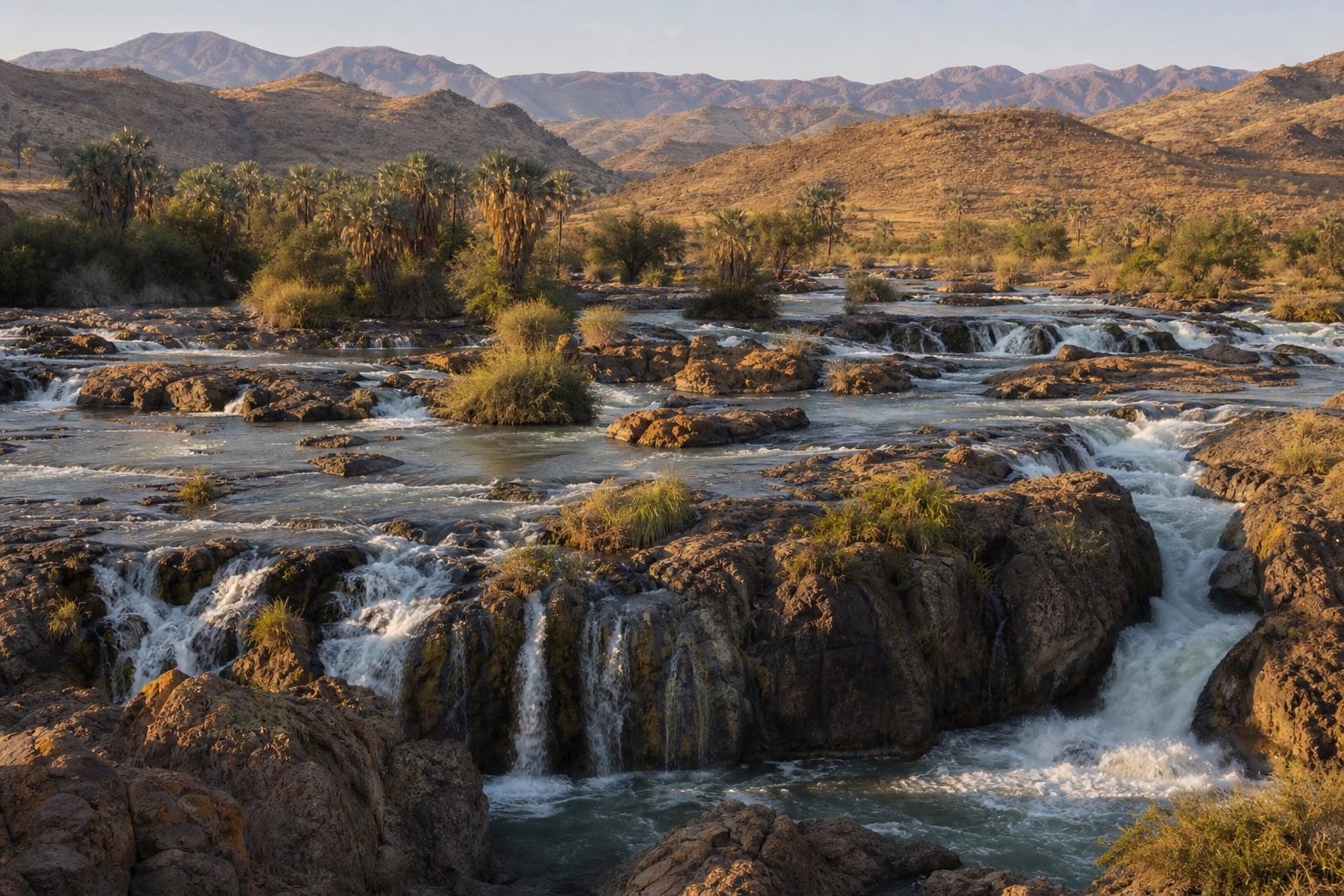
The opposite bank is another country

Epupa Falls is not an assumed Angola crossing

The river marks the international boundary, but a view across it—or a local path, island, boat, or shallow-looking channel—does not create immigration permission. Plan the falls as a Namibia-side destination unless a separately researched Angola itinerary uses a recognized port of entry with current documents and authorization.

Namibia’s immigration ministry identifies Ruacana as a formal Namibia–Angola border post; no official source reviewed identifies Epupa itself as a port of entry. Recheck immigration rules, visas, vehicle permission, insurance, fees, health requirements, and operating hours directly before any cross-border journey.

Review current travel checks

Build resilience before Opuwo

Vehicle, fuel, communications, and emergency checks

The goal is not to make the route sound difficult; it is to ensure a puncture, missed junction, washed section, closed activity, or lost signal remains manageable.

Vehicle and tyres

Match ground clearance, tyre type, spare-wheel provision, tools, driver experience, and rental permission to the current approach. A recommendation from one property or season is not a universal vehicle rule.

Fuel and supplies

Fill at the last confirmed reliable opportunity and calculate range for the destination, local movements, detours, and return. Carry drinking water and essential food even when meals are reserved.

Navigation and check-in

Save the exact property coordinates, written directions, junction landmarks, contact numbers, booking proof, and backup stop offline. “Epupa Falls” is not precise enough for a night arrival.

Communications and emergency

Agree on a missed-arrival procedure with the property and leave the route with someone outside the vehicle. Confirm insurer and rental-company contacts, and do not assume rapid roadside, medical, or rescue response.

Use real overnight anchors

Epupa Falls route pairings

Epupa works best as a deliberate northwestern extension. Keep Opuwo in the plan, avoid stacking remote legs, and research any northern continuation independently.

The clearest first plan

Opuwo → Epupa Falls → Opuwo

Use Opuwo for a rested resupply and a current road check, then give Epupa its own two-night block. Return by the agreed route unless reliable local advice supports a different onward plan.

A staged northwestern extension

Damaraland / Palmwag → Opuwo → Epupa

Do not treat Palmwag, Opuwo, and Epupa as one transfer. Break the route at a real service and overnight point, and keep cultural visits separate from a pressured arrival day.

A condition-dependent extension

Epupa → northern Namibia via a legal route

A Ruacana or northern connection requires current road information, fuel, accommodation, and border awareness. Do not improvise a river crossing or add remote valleys and passes without specific capability and support.

Protect river, land, and shared space

Leave no new track, waste, disturbance, or assumption

Follow stricter local instructions whenever they differ from this baseline. The river corridor is home, working land, wildlife habitat, and a water source—not an empty backdrop.

  • Use the agreed vehicle track, parking area, campsite, viewpoint, and footpath. Do not create a riverbank shortcut or drive around a damaged or closed section.
  • Use designated toilets and waste systems. Pack out anything the property or settlement cannot accept, including batteries, broken equipment, food waste, and hygiene products.
  • Keep soap, detergent, fuel, oil, food scraps, and wastewater out of the river and away from drainage lines. Follow the accommodation’s exact water-disposal instructions.
  • Light fires only where and when the property or local authority permits. Bring or buy approved fuelwood; do not remove living or dead vegetation from the river corridor.
  • Do not remove stones, plants, seeds, wood, feathers, cultural material, or wildlife remains, and do not stack rocks, carve surfaces, or leave painted marks.
  • Keep music, drones, lights, generators, and voices from burdening residents, other guests, livestock, and wildlife. Obtain current permission before any drone flight.

Questions worth settling before you go

Is Epupa Falls a national park?

This guide does not describe it as one. It is a river-and-settlement destination with local properties, access arrangements, community institutions, and an international boundary. Confirm rules with the exact site, host, or guide.

Can I swim in the Kunene at Epupa?

No. Do not swim or wade in the Kunene at Epupa. Moving water, cascade edges, uncertain depth and footing, freshwater-health risks, and crocodiles make casual water entry unsafe. Follow current local restrictions and use only a specifically managed river activity.

Do I need a 4x4 from Opuwo?

There is no all-date answer. A local operator recommends one, especially in rainy conditions, but the right choice depends on the current road, final property access, ground clearance, tyres, driver experience, and rental contract. Ask shortly before travel.

Can I visit Epupa as a day trip from Opuwo?

It may be physically possible in favorable conditions, but it creates a long return with little margin for walking, stops, heat, or road changes. A two-night stay is the stronger default for most self-drive itineraries.

When is the waterfall flow best?

No month guarantees the view you have seen in photographs. River flow and the pattern across the channels vary with upstream rainfall and current conditions. Ask a local property for a recent description, then plan a stay that does not depend on one volume.

Can I cross into Angola at the falls?

Do not plan on it. Treat the river as the international boundary and use a recognized port of entry for any Angola journey, with current immigration, visa, vehicle, insurance, and health requirements confirmed in advance.

Is Epupa suitable for children or travelers with limited mobility?

It can be for some families and mobility needs, but the exact property and route matter. Ask about river barriers, pool safety, path surface, slopes, steps, exposed edges, shade, toilets, room access, and the experience available without a steep walk.

Planning essentials

Give Epupa enough time to stay flexible

Start with two nights and a daylight approach through Opuwo. Then fit the falls walk, one locally arranged activity, river conditions, and the next overnight stop into a plan that still works if flow, heat, road, or signal changes.

Useful minimum

Two nights at Epupa

This creates a full middle day and separates the remote approach from the falls walk. Add time only for a specific guided activity or a deliberate rest day.

Route anchor

Stage through Opuwo

Use the town for fuel, supplies, tyre and cash checks, then obtain current directions from the booked property. Do not attach the plan to a fixed drive time.

Safety priority

River, heat, and return margin

Plan each walk around current conditions and a safe turnaround. Never infer swimming safety, border permission, or waterfall flow from a photograph.

Ways to structure an Epupa Falls visit

OptionBest for
Nearby day visitorTravelers already based close to Epupa who want one falls walk with a conservative daylight return.
Two-night stayMost self-drive routes: one approach day, one usable local day, and a fresh departure morning.
Three or more nightsBirding, slower travel, a community-controlled visit, or a condition-dependent guided river activity.

Before you book

  • Confirm the exact property, coordinates, accommodation product, check-in plan, meals, drinking water, power, bathroom, mosquito protection, payment method, and cancellation terms.
  • Ask the property for a recent road update, recommended approach, current vehicle needs, rainfall effects, fuel plan, and a contact for the travel day.
  • Carry offline directions, enough fuel range, drinking water, food contingency, tyre tools, two usable spares when required by the route plan, medication, and emergency contacts.
  • Ask about current river level, approved viewpoint routes, guided-walk terrain, heat, crocodile precautions, closures, and whether any water activity is operating.
  • For a Himba visit, confirm invitation, local control, guide role, participant payment, individual photography consent, group size, and how children’s privacy is protected.
  • Treat the river as an international boundary and Epupa as a destination, not a crossing. Use a recognized border post with current immigration and vehicle documents for any Angola itinerary.
  • Leave the route and arrival window with someone outside the vehicle, agree on a missed-arrival response, and review the latest Namibia travel advisory before departure.

Make Epupa the destination—not the rushed end of a driving day

Stage through Opuwo, reserve two nights, and let current road, river, heat, and local guidance shape the exact visit.

Open Route Planner