Protected desert setting
Deadvlei is a clay pan in Namib-Naukluft Park, within the UNESCO-listed Namib Sand Sea. Treat the pan, trees, dunes, and approach as protected landscape rather than a photography set.
Home / Destinations / Deadvlei
A practical plan for reaching, walking, and photographing Namibia's protected clay pan with less rush and less impact.
A focused companion guide
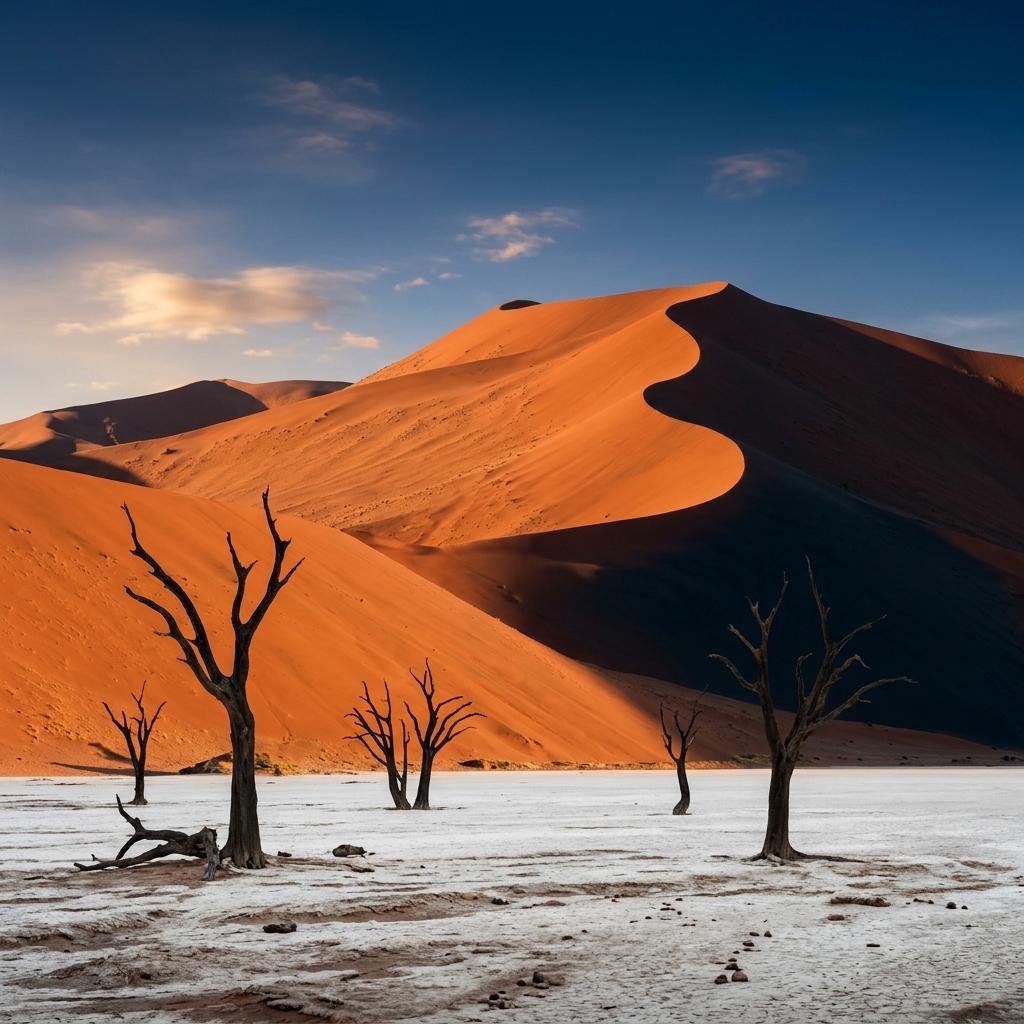
Deadvlei is the pale clay pan known for dark standing camel-thorn remains and a backdrop of red dunes. It lies in Namib-Naukluft Park within the UNESCO-listed Namib Sand Sea. Published estimates of the trees' age vary, so a precise number is less useful than the practical point: they are fragile, protected features and must be left untouched.
Deadvlei and Sossusvlei are distinct pans within the same wider visitor area. This page concentrates on the final access choice, the exposed walk, photography, and low-impact behaviour. Use the broader Sossusvlei guide for accommodation, route position, dunes, and Sesriem Canyon.
Read the landscape
River flooding once brought water into the depression. Camel-thorn trees could grow where today you see the pale, dry pan.
Shifting sand blocked the river's access to this pan. With the water supply lost, the trees died.
The very dry setting slowed decay, leaving the standing trunks that make Deadvlei recognisable. They are fragile remains, not climbing structures.
Sossusvlei is a separate pan that can receive water after exceptional rains. Do not use a photograph of Deadvlei's dead trees to identify both pans as the same place.
Explanation checked 23 September 2026 against NASA's Deadvlei explanation, NWR's tree-conservation note and NTB's pan description. Published age figures do not establish an exact age for every tree; this guide does not assign one.
Know which stop you mean
The gate, roadside dunes, parking area and pans are separate places. Allow for the road journey, the final transport arrangement and the walk, as well as time at your chosen sight.
Park entry, accommodation access and a separate canyon visit. Confirm your gate and return deadline here.
A stop off the main approach road. It is separate from the dunes around Deadvlei.
The end of the tarred approach. Confirm the authorised transport arrangement before the sand section.
The vehicle journey ends before the pan. The sandy approach and return are on foot.
Deadvlei has the standing dead trees; Sossusvlei is a different pan. Big Daddy is a separate, optional climb near Deadvlei.
Two distances to keep separate
The roughly 60 km approach is a drive from Sesriem to the 2×4 parking area. NTB's roughly 1.1 km description refers to the walk towards Deadvlei; leave time and water for the return too. Neither figure is a door-to-pan journey time.
Layout references checked 23 September 2026: Namibia's 2013 World Heritage nomination (tarred approach and Dune 45 access); the ministry's Sossusvlei brochure, archived by EIS (sand section); NTB Southern Region (walking approach). These describe the layout, not today's access permission.
Deadvlei is a clay pan in Namib-Naukluft Park, within the UNESCO-listed Namib Sand Sea. Treat the pan, trees, dunes, and approach as protected landscape rather than a photography set.
Namibia Tourism Board describes a roughly 1.1 km walk through the dunes. The actual effort depends on the current drop-off point, heat, wind, route markings, and your pace.
The 2×4 parking area, sand transfer and walking approach are separate stages. Check permission before self-driving and confirm the exact departure and return point for a booked transfer.
The exposed walk and pan can become demanding as the day warms. Carry water and sun protection, watch your turnaround margin, and do not let a photograph override heat or wind conditions.
Arrival to exit
The most useful schedule is built backward from the return deadline. Access arrangements can change, so confirm the day's rules before committing to the drive and walk.
Confirm the permit process, current park closing time, road status, shuttle departure point, and return arrangements at the gate or with your accommodation. Written information is more useful than an old screenshot or blog post.
Keep to official roads and directions. Leave room for slower vehicles and photo stops, and do not build the schedule around an exact driving time: traffic, weather, visibility, and surface conditions all matter.
Use the current shuttle or proceed only if the route is open, the vehicle and rental agreement allow it, and the driver has relevant sand experience. Four-wheel drive is useful equipment, not a substitute for judgement.
The approach crosses loose sand and has limited shade. Note landmarks and signs, keep your group together, and turn back early if heat, wind, footwear, mobility, or water supply makes the return uncertain.
Allow for the walk back, transport queues, and the drive to Sesriem before the applicable park deadline. Avoid pairing Deadvlei with an ambitious same-day gravel-road transfer.
NWR announced that its Deadvlei shuttle moved from the 2x4 area to Sesriem Campsite in October 2024, and its current campsite page still lists a Deadvlei shuttle. That does not make an old timetable, price, or departure assumption reliable for your date.
Read the NWR noticePhotography without a shot guarantee
Wind, haze, cloud, dune shadow, and visitor movement all change the scene. A flexible approach usually produces a calmer visit than racing to recreate a photograph made under different conditions.
Lower-angle light can separate the dark tree forms from the bright pan and shaded dunes. The exact look changes with season, cloud, dust, and your position, so arrive with ideas rather than one guaranteed frame.
A wider view shows the pan and dune walls; a short telephoto can isolate trunks, dune curves, and small groups of trees. A phone can do both—clean the lens often and protect it from blowing sand.
Keep spare batteries and cleaning supplies protected, change lenses sparingly in blowing sand, and stabilise tripods without pushing them against trees or other natural features.
The familiar centered-tree composition is only one option. Look for negative space, dune shadow, texture, and scale, then move on so other visitors can photograph without being directed or displaced.
Protected landscape
NWR's published park regulations prohibit leaving signed roads, disturbing plants or animals, damaging objects, littering, and ignoring park officials. The practical application at Deadvlei is simple: make the image without changing the scene.
No. They are distinct pans in the wider Sossusvlei visitor area. Plan the transport and walking for each stop instead of treating the names as interchangeable.
You need a safe plan for the final sand section, not necessarily a promise to drive it yourself. Ask where your vehicle must stop and verify the current shuttle. If self-driving, the vehicle, rental terms, route status, and driver experience all need to align.
Early visits can offer cooler walking and directional light, but access, season, cloud, dust, and crowds change the result. The safest useful time is one that leaves enough margin for the return and park rules.
Official and tourism sources publish estimates, but they do not establish a precise age for every tree. The useful story is how river water supported growth, dunes cut off that water and dryness preserved the remains. Read the sourced explanation.
Not without official permission. MEFT's 2025 reminder says drones are not allowed in national parks without a permit and must be declared and registered at the entry gate. Confirm the process before carrying one into the park.
Planning essentials
Deadvlei works best as a deliberate outing with a confirmed transport plan and generous return margin. The choices below matter more than trying to predict an exact arrival minute.
Useful base
Where you sleep affects gate access, pre-departure driving, and how much margin you have. Confirm the rules attached to the exact property and booking date.
Core decision
Settle the final-access plan before arrival. Do not rely on a quoted price, departure point, or timetable unless the provider has reconfirmed it for your date.
Route rhythm
Deadvlei, Sossusvlei, dune climbs, and Sesriem Canyon are separate stops. Prioritise rather than trying to complete every landmark before a long onward drive.
| Option | Best for |
|---|---|
| Authorised shuttle / transfer | Travelers avoiding independent sand driving or using a vehicle that should stop before the deep-sand section. |
| 4×4 self-drive, when authorised | Drivers with a suitable vehicle, rental permission, and genuine soft-sand experience. |
| Organised excursion | Travelers who prefer the access, timing, and interpretation to be coordinated by their lodge or a registered operator. |
Leave enough space for gate checks, the access decision, the sandy walk, changing light, and the return—not just the photograph.
Open Route Planner